
Winning Denial Appeals: A Framework For Internal Medicine Practices

Claim denials are not just a billing nuisance in primary care. In internal medicine, they interrupt cash flow, consume staff time, and often expose deeper process failures in documentation, coding, authorization, and payer follow-up. That is why internal medicine denial appeals should never be treated as a last-minute reaction. They work best when they are built into a repeatable revenue cycle process from the start.
This matters even more now because denials remain common while formal appeals are often underused. KFF reported that insurers on HealthCare.gov denied 20 percent of claims in 2023, while fewer than 1 percent of denied claims were appealed. Even when appeals were filed, insurers upheld 56 percent of internal appeals. That does not mean appeals are futile. It means most organizations still need a better process for deciding which denials to fight, how to support them, and how to prevent the same denial from happening again. KFF
In internal medicine, the challenge is rarely limited to one issue. A denied claim may begin with a front-end eligibility problem, but it may also involve weak medical necessity support, a missed prior authorization, an E/M level dispute, incomplete modifier logic, or a payer policy mismatch. Internal medicine practices also carry a high volume of chronic disease follow-up, medication management, and moderate-complexity visits that are easy to undersell if documentation is not aligned with current coding rules. CMS.gov American Medical Association
For practices that want a broader specialty billing view, our page on Internal Medicine Billing Services shows how denial management fits into a stronger revenue cycle process.
The most effective appeal teams do not start by writing letters. They start by triaging the denial, validating the economics, matching the denial to the payer’s exact rationale, and building evidence that a payer reviewer can quickly follow. That is the difference between an appeal that sounds persuasive and one that gets paid.
Why internal medicine practices lose appeals they should win
Many appeals fail before the letter is even written. The common problem is not effort. It is a misalignment.
A team receives a denial, assumes it is a documentation issue, and sends a generic appeal. But the denial may actually be tied to a payer edit, a missing authorization detail, a modifier issue, or a timely filing problem. When the response does not answer the payer’s stated reason, the appeal becomes administrative noise. AHIMA recommends an organized denial-resolution process with clear ownership, corrective actions, deadlines, and regular follow-up rather than one-off rework. Journal of AHIMA
Internal medicine practices are especially vulnerable when they do not separate soft denials from hard denials. A soft denial usually needs correction and resubmission. A hard denial often requires a formal appeal supported by documentation and payer criteria. When staff use the same workflow for both, valuable time gets wasted and appeal windows shrink.
A practical framework for internal medicine denial appeals
Strong internal medicine denial appeals follow a five-part framework: triage, payer-rule matching, evidence assembly, letter construction, and closed-loop follow-up.
Step 1: Triage the denial before anyone starts writing
Not every denial deserves the same response. Start with three questions:
- What exactly did the payer deny
- Is this a corrected-claim issue or a formal appeal issue
- Is the claim financially worth pursuing
This first step sounds basic, but it is where many practices save the most time. A clean appeal workflow should identify the payer, denial code, claim amount, filing deadline, prior appeal status, and root-cause category before the case is assigned. Emerald Health’s own denial-tracking guidance is right on this point: practices should track denials by payer, root cause, denied dollars, owner, and appeal outcome every month. Emerald Health LLC
A practical internal rule is to separate claims into three buckets:
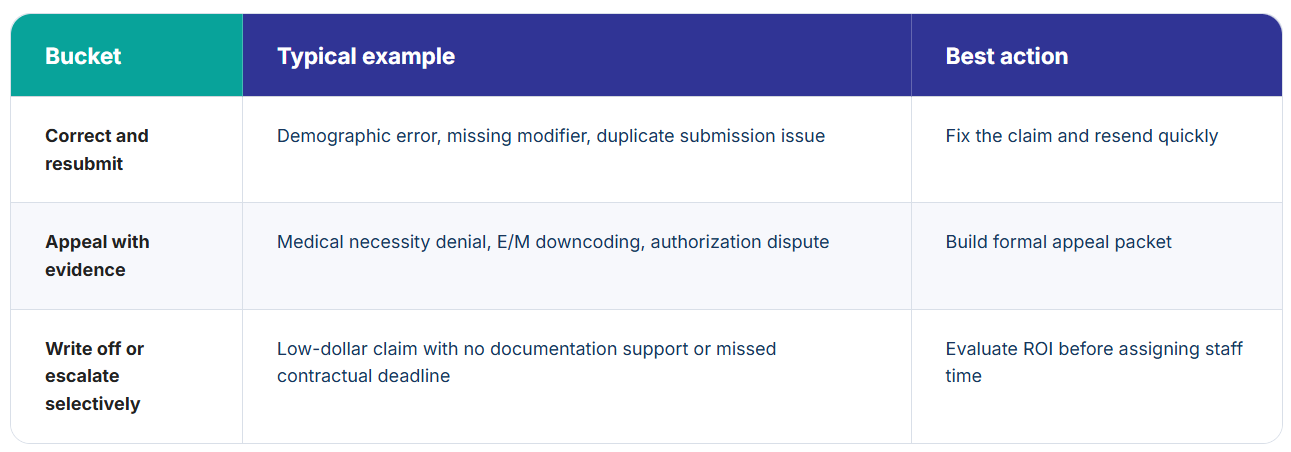
This is where internal medicine denial appeals become a management process instead of a clerical task.
Step 2: Match the denial to the payer’s exact rule
The denial notice tells you where to aim. Use it.
If the payer says the service was not medically necessary, the appeal must connect the patient’s symptoms, comorbidities, progression, testing, and treatment plan to the payer’s criteria. If the payer reduced an E/M level, the appeal must show why the documented medical decision making or total time supported the submitted code. If the denial involves prior authorization, the packet should show approval details, request history, or why the case qualified for reconsideration.
Beginning in 2026, impacted payers must provide a specific reason for denied prior authorization decisions, which gives practices a more actionable basis for correction or resubmission. That is a meaningful operational advantage if staff capture the exact reason and respond to it precisely. CMS.gov
This is also where your team can naturally refer readers to related education on the top causes of medical claim denials if they need a broader prevention view.
Step 3: Build an evidence packet the reviewer can score quickly
The most successful internal medicine denial appeals are easy to review. They do not bury the payer in a chart dump.
At minimum, the packet should include the denial letter, the original claim, the relevant progress note, any supporting test results, medication history when relevant, authorization records if applicable, and a short provider statement when medical necessity or complexity is in dispute. AHIMA notes that strong appeals may also require provider queries, supporting articles, and targeted documentation that proves the coding and medical decision making were appropriate. Journal of AHIMA
For internal medicine, the evidence should usually answer questions like these:
- What chronic conditions were addressed
- What changed clinically
- What risk did the provider manage
- What testing or record review influenced decisions
- What medication decisions raised complexity
- Why was the billed level medically necessary that day
When a payer reduces E/M levels, the defense has to match current CMS rules. Office and outpatient E/M levels are selected by medical decision making or total time, not by counting history and exam elements the way many teams were trained years ago. CMS is explicit on that point, and the AMA has also warned that payer downcoding programs may not reflect current E/M guidance accurately. CMS.gov American Medical Association
Step 4: Write the appeal letter like a reviewer thinks
A good appeal letter is not emotional and it is not vague. It is brief, factual, and structured around the reviewer’s decision path.
A practical layout looks like this:
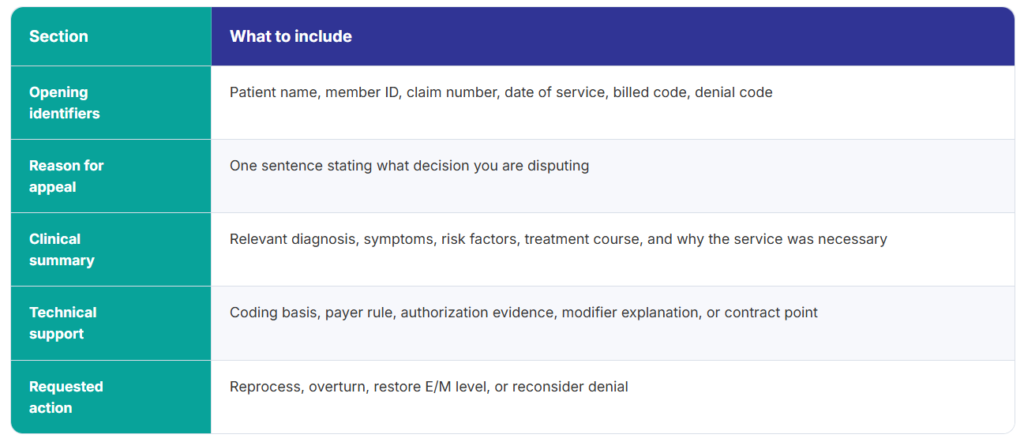
For E/M downcoding, be direct. If the documentation supports moderate MDM, say that clearly. If the appeal relies on time, document the total time exactly as required. CMS states that when time is used to support E/M billing, the record must show the total time or start and stop times, and medical necessity remains the primary basis for payment. CMS.gov
For payer downcoding or unexplained reductions, the AMA recommends including patient identifiers, the remittance advice, the affected line item, expected versus received payment, the basis for the dispute, and supporting documentation. The AMA also states that automatic downcoding without medical record review is not appropriate. American Medical Association
Step 5: Track deadlines, escalate correctly, and close the loop
The appeal is not finished when it is submitted. This is where collections are often lost.
Your team should log the submission date, acknowledgment, next follow-up date, payer reference number, and escalation path. If the first-level appeal is denied, decide quickly whether the case should move to a second-level review, peer-to-peer, contract dispute review, or write-off analysis.
For ACA-regulated plan appeals, CMS notes that members generally have up to 180 days to file an internal appeal, with internal appeal decisions typically completed within 30 days for pre-service claims and 60 days for post-service claims. Urgent cases move faster. Provider-facing appeal rules vary by payer and contract, but the operational lesson is the same: missed deadlines destroy otherwise recoverable claims. Centers for Medicare & Medicaid Services (CMS)
AHIMA’s guidance is also practical here: assign responsibility, correct denials quickly, follow a decision-tree process, and monitor whether the corrective action actually reduces repeat denials. Journal of AHIMA
The documentation details that win more appeals
E/M disputes require current rule knowledge, not old habits
Internal medicine is especially exposed to E/M disputes because chronic care follow-up can look routine on the surface while still meeting moderate complexity. CMS guidance makes clear that visit levels depend on MDM or total time, and history and exam alone do not drive code selection. When a payer downcodes a visit, the appeal should map the note to the actual elements that support the billed level. CMS.gov
If your team is working through repeat E/M or specialty-specific issues, it is natural to reference your internal page on internal medicine medical billing services because that keeps the article connected to your specialty expertise without sounding promotional.
Medical necessity denials are won with specificity
A reviewer cannot approve what the chart does not clearly show. General statements like “patient required continued management” are weak. A stronger appeal states the number of chronic conditions addressed, the medication decisions made, the test results reviewed, the risk monitored, and the reason lower-intensity management would have been insufficient.
This is also why newer ranking content in 2026 performs better when it includes specialty examples, denial categories, and operational fixes instead of generic commentary. Competitor content that ranks in this space tends to use structured headers, denial tables, and step-by-step workflows, but there is still room to outperform it with a more grounded, biller-style framework. Medibill RCM LLC Emerald Health LLC
Appeal data should feed prevention
A denial appeal should end with a root-cause decision.
Was the denial caused by registration error, authorization failure, E/M under-support, modifier misuse, timely filing, or payer policy drift? If your practice does not answer that question, you may win one claim and still lose the next fifty.
That is why monthly reporting matters. Denials should be reviewed by payer, reason code, denied dollars, turnaround time, and overturn rate. Emerald Health’s own denial-tracking guidance and AHIMA’s process recommendations both support this kind of structured review. Emerald Health LLC Journal of AHIMA
KPIs that show whether your appeal process is actually working
The following metrics tell you whether your workflow is improving:
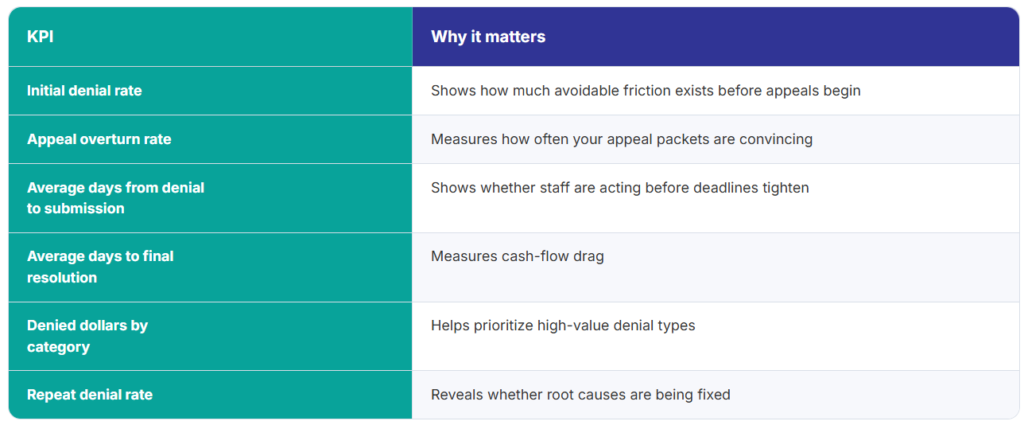
If your team needs a supporting educational link here, your article on monthly denial tracking solutions is the strongest companion piece.
A practical next step for practice leaders
If an internal medicine practice wants to improve appeal performance, the first move is not to tell staff to “work denials harder.” The first move is to audit the process.
Review the last 60 to 90 days of denials. Group them by payer, denial type, code family, provider, and denied dollars. Pull a sample of E/M denials, authorization denials, and medical necessity denials. Then ask three practical questions: did we appeal the right claims, did we submit the right evidence, and did we fix the upstream workflow that caused the denial in the first place.
That kind of review builds trust with physicians because it shows the billing team is not just reacting to denials. It is protecting revenue with a disciplined process.
Conclusion
Winning denied claims in internal medicine is rarely about writing longer letters. It is about using a better system. The practices that recover more revenue are the ones that triage denials correctly, align every appeal to the payer’s stated reason, support each argument with focused documentation, and track outcomes closely enough to prevent repeat mistakes.
When internal medicine denial appeals are handled this way, the practice gains more than recovered dollars. It gains cleaner workflows, stronger documentation habits, better payer accountability, and a more stable revenue cycle.
FAQ
What is the first step in appealing a denied internal medicine claim?
The first step is to identify the exact denial reason, confirm whether the claim needs correction or formal appeal, and review the deadline, claim value, and required documentation before assigning the case.
What documentation is most important in an internal medicine appeal?
The most important items are the denial notice, original claim, relevant progress note, supporting labs or diagnostic results, authorization records if applicable, and a focused provider statement when medical necessity or E/M level is disputed.
Are all denied internal medicine claims worth appealing?
No. Practices should weigh timely filing limits, documentation strength, appeal effort, and claim value. Some claims should be corrected and resubmitted, some should be formally appealed, and some may not justify the labor cost.
How do internal medicine practices win E/M downcoding appeals?
They win by showing that the submitted code was supported by current E/M rules based on medical decision making or total time, with documentation that clearly supports medical necessity and the level billed.
How can a practice reduce repeat denials after an appeal?
By tracking denials by payer, root cause, dollars, turnaround time, and overturn rate, then using that data to retrain staff, tighten workflows, and correct documentation gaps before the next billing cycle.